
table of contents
- The Upside
- The Downside
- General Partnership
- Limited Partnership
- Key Considerations for Partnerships
- Why the LLC Is So Popular
- Types of Corporation
- C Corporation
- S Corporation
- The Main Trade-off
- What are the 4 main types of business structures?
- Which type of business offers the best liability protection?
- What is the easiest business type to set up?
- Can a sole proprietorship become an LLC later?
- What type of business is a Free Zone company in the UAE?
- Is a corporation better than an LLC?
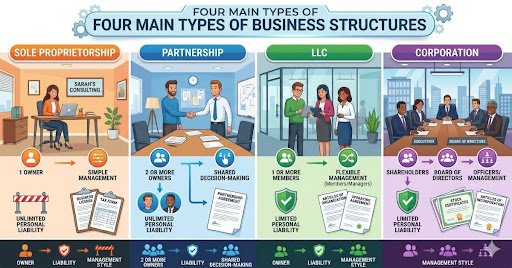
The 4 main types of business are sole proprietorship, partnership, limited liability company (LLC), and corporation. Each structure differs in how it handles ownership, liability, taxation, and management. Choosing the right one depends on your goals, the number of people involved, and how much legal protection you need.
Key Takeaways
- The 4 main business types are sole proprietorship, partnership, LLC, and corporation.
- A sole proprietorship is the simplest to start but offers no personal liability protection.
- Partnerships split ownership between two or more people, either equally or by agreement.
- An LLC combines the simplicity of a sole proprietorship with meaningful liability protection.
- Corporations are more complex to set up but are better suited to raising investment and scaling.
- In the UAE, the equivalent structures include sole establishment, civil company, LLC, and Free Zone entity.
Why the Business Structure You Choose Matters
Most people focus on the idea, the product, or the market. Very few spend enough time thinking about how their business is actually structured, and that decision can have a significant impact on how much tax you pay, whether your personal assets are at risk, and how easy it is to bring in partners or investors later.
The four main business types are not just legal categories. They represent fundamentally different ways of operating, different relationships with liability, and different paths for growth. Understanding each one before you commit is one of the most practical things you can do as a business owner.
1. Sole Proprietorship
A sole proprietorship is the most basic business structure. It is owned and operated by a single person, and in the eyes of the law, the owner and the business are treated as one and the same entity.
There is no formal registration process required in many countries beyond obtaining any necessary licenses or permits. You simply start operating and declare the income as your own.
The Upside
- Simple and inexpensive to set up, in most places you just start trading.
- Full control: every decision is yours to make.
- Straightforward tax reporting, business income is filed as personal income.
- Minimal ongoing compliance or administration.
The Downside
- No separation between personal and business liability. If the business owes money, your personal assets, savings, property, car, can be used to settle those debts.
- Difficult to bring in partners or investors without restructuring entirely.
- Harder to build credibility with larger clients who prefer dealing with registered companies.
Sole proprietorships work well for freelancers, consultants, and anyone testing a business idea before committing to a more formal structure. In the UAE context, the equivalent is a sole establishment, a Mainland license under an individual’s name with the same benefits and limitations.
2. Partnership
A partnership is a business owned by two or more people. Like a sole proprietorship, it is relatively straightforward to set up, but now there are multiple owners involved, which means decisions, profits, and liabilities are all shared.
There are two main variations worth knowing:
General Partnership
In a general partnership, all partners share equally in both the management and the liabilities of the business. If the partnership takes on debt or gets sued, every partner is personally exposed. This structure makes sense when all partners are actively involved and trust each other’s judgment completely.
Limited Partnership
A limited partnership has at least one general partner, who runs the business and carries unlimited liability, and one or more limited partners, whose liability is capped at the amount they have invested. Limited partners are typically investors who want exposure to the business without taking on management risk.
Key Considerations for Partnerships
- A written partnership agreement is essential. Without one, disputes are governed by default rules that may not reflect what you actually agreed.
- Profits and losses pass through to each partner’s personal tax return in most jurisdictions.
- Adding or removing a partner often requires dissolving and reforming the business unless the agreement specifies otherwise.
- General partners carry personal liability, the same exposure as a sole proprietor, just shared.
In the UAE, the closest equivalent to a general partnership is a civil company, commonly used by professionals such as doctors, lawyers, and engineers who want to practice together under a shared entity.
3. Limited Liability Company (LLC)
The LLC is arguably the most versatile business structure available today. It takes the simplicity of a sole proprietorship or partnership and layers on one critically important feature: limited liability. This means that if the business runs into financial trouble or faces a lawsuit, the personal assets of the owners, called members, are protected.
The LLC is a separate legal entity from its owners. The business can own property, enter contracts, open bank accounts, and be sued, independently of the individuals behind it.
Why the LLC Is So Popular
- Personal liability protection for all members.
- Flexible management, can be managed by members themselves or by appointed managers.
- Pass-through taxation in most jurisdictions, profits taxed at the individual level, not the company level.
- Flexible profit distribution, members can agree on any split, regardless of ownership percentage.
- Fewer formalities and lower cost than a corporation.
In the UAE, the LLC structure is used primarily for Mainland businesses and is one of the most common business types for foreign investors. It requires at least one shareholder and allows up to 50 shareholders under the UAE Commercial Companies Law. Free Zone companies also operate under a similar limited liability principle, often referred to as FZ-LLC.
4. Corporation
A corporation is a fully independent legal entity, the most structurally separate from its owners. It can own assets, enter contracts, sue and be sued, and continues to exist even if the original owners leave, sell their shares, or pass away.
Corporations are typically owned by shareholders, managed by a board of directors, and operated by appointed officers. They are the structure of choice when a business wants to raise significant capital, go public, or operate at enterprise scale.
Types of Corporation
C Corporation
The standard corporate structure. Profits are taxed at the corporate level and again when distributed as dividends to shareholders, a situation often called double taxation. C Corporations can have unlimited shareholders, including foreign investors, making them the preferred vehicle for businesses seeking venture capital or planning to list publicly.
S Corporation
An S Corporation passes profits and losses directly through to shareholders’ personal tax returns, avoiding corporate-level tax. The trade-off is significant restrictions, limited to 100 shareholders, all of whom must be US citizens or permanent residents. This structure is specific to the United States tax code.
The Main Trade-off
- More formalities: annual meetings, board resolutions, detailed record-keeping.
- Higher setup and maintenance costs than an LLC.
- Better positioned for large-scale growth, external investment, and exit strategies.
In the UAE, large corporations and listed companies operate under similar structures governed by the UAE Commercial Companies Law. Free Zone entities that operate at scale often use a joint stock company structure which reflects the corporate model.
Side-by-Side Comparison
| Feature | Sole Prop. | Partnership | LLC | Corporation |
|---|---|---|---|---|
| Liability protection | None | None / Partial | Yes | Yes |
| Setup complexity | Very low | Low | Moderate | High |
| Multiple owners | No | Yes | Yes | Yes |
| Investment-ready | No | Limited | Moderate | Yes |
Which Business Type Is Right for You?
There is no universal answer, it depends on where you are in your business journey and what you are trying to protect or achieve.
- Just starting out solo, low risk, testing an idea: a sole proprietorship or its equivalent gets you moving without overhead.
- Working with one or more partners and want clarity on ownership: a partnership with a solid written agreement.
- Want liability protection without corporate complexity: an LLC is usually the right call for most small to mid-size businesses.
- Planning to raise investor funding, issue shares, or scale significantly: a corporation gives you the structure for that.
In the UAE specifically, the Free Zone LLC is the most popular starting point for individual entrepreneurs and foreign investors, it covers most needs, processes quickly, and comes with the added benefit of UAE residency eligibility.
Frequently Asked Questions
What are the 4 main types of business structures?
The 4 main types are sole proprietorship, partnership, limited liability company (LLC), and corporation. Each has a different approach to ownership, liability, taxation, and management complexity.
Which type of business offers the best liability protection?
Both LLCs and corporations offer limited liability protection, meaning owners are not personally responsible for business debts in most circumstances. Of the two, corporations provide the most formal separation but come with greater complexity.
What is the easiest business type to set up?
A sole proprietorship is the simplest to start, in many places you just begin operating and declare income as your own. However, it offers no liability protection, so it is best suited to low-risk activities.
Can a sole proprietorship become an LLC later?
Yes. Many businesses start as sole proprietorships and convert to an LLC once they grow or need liability protection. The process involves formally registering the LLC and transferring assets and contracts to the new entity.
What type of business is a Free Zone company in the UAE?
A Free Zone company in the UAE typically operates as a Free Zone LLC (FZ-LLC), it is a limited liability entity, meaning owners are protected from personal liability. It is the UAE equivalent of an LLC and is the most common structure for foreign entrepreneurs registering in the UAE.
Is a corporation better than an LLC?
Not necessarily, it depends on your goals. Corporations are better for businesses seeking outside investment or planning to go public. LLCs are better for most small to medium businesses that want simplicity, flexibility, and liability protection without the administrative burden of a corporation.
Final Thoughts
The business structure you choose is one of those early decisions that is easy to overlook and difficult to undo later. Getting it right from the start, or understanding where you currently sit and whether it still fits, is worth the time.
The four main types cover the full spectrum from informal solo trading to large-scale investment vehicles. Most serious entrepreneurs land somewhere in the LLC space: enough protection to operate without constant worry, enough flexibility to run things without corporate red tape.
post tags :
Freelance Visa & Digital Nomad Visa Dubai
Whether you’re a creative designer, tech developer, marketer, consultant, or remote employee working for an overseas company — the Freelance Visa Dubai and Digital Nomad Visa Dubai give you the freedom to live and work legally in the UAE while enjoying a modern lifestyle and tax-free income.