
table of contents
- Key Takeaways
- What LLC Ownership Actually Means
- Type 1: Sole Ownership (Single-Member LLC)
- Type 2: Joint Ownership (Multi-Member LLC)
- Type 3: Corporate or Entity Ownership
- Type 4: Managed Ownership
- Ownership Transfers: What Happens When Someone Leaves?
- LLC Ownership in the UAE: Key Points
- Frequently Asked Questions
- Final Thoughts
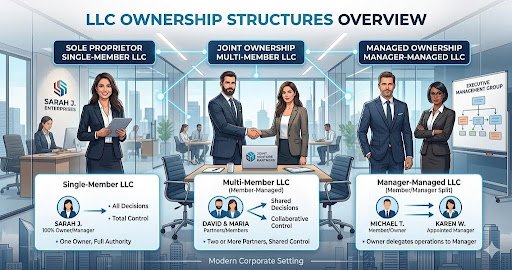
LLC ownership refers to how a limited liability company is held and controlled. The main types are sole ownership (one member), joint ownership (multiple members), and managed ownership (where operations are handled by an appointed manager rather than the owners). Each type determines who controls the business and how profits and decisions are divided.
Key Takeaways
What LLC Ownership Actually Means
Ownership of an LLC is expressed through membership interest, the percentage of the company a member holds. This percentage is the foundation for most things that matter: how profits are distributed, how much voting power a member has, and what happens to the business if someone wants to leave.
Unlike shares in a corporation, membership interest in an LLC is not divided into stock that can be freely bought and sold. Transferring ownership typically requires the consent of other members and is governed by the operating agreement. This makes ownership in an LLC more deliberately structured than in a corporation, which can be both an advantage and a limitation depending on your goals.
Understanding the type of ownership structure you have, or want, before you form an LLC is not a minor detail. It affects how decisions get made, how the business is taxed, and how clean or complicated your exit options are.
Type 1: Sole Ownership (Single-Member LLC)
In a sole-ownership LLC, one person holds 100% of the membership interest. There are no other stakeholders to consult, no profit-sharing arrangements to navigate, and no disagreements over direction. Every decision sits with the single member.
How Ownership Works
The sole owner is the LLC. All assets, income, and liabilities of the business flow to that one person, at least in terms of tax treatment. In the United States, the IRS treats a single-member LLC as a disregarded entity by default, meaning the business income is reported directly on the owner’s personal tax return.
Pros of Sole Ownership
Cons of Sole Ownership
In the UAE context, a sole-ownership Free Zone LLC is the most common structure for individual entrepreneurs and foreign professionals. It allows one person to hold 100% of the company, obtain a UAE trade license, and apply for a residency visa, all under a single registered entity.
Type 2: Joint Ownership (Multi-Member LLC)
Joint ownership means two or more people hold membership interest in the same LLC. This is the natural structure for business partnerships, co-founder arrangements, and family businesses where multiple people have a stake.
How Ownership Is Divided
Membership interest is typically assigned as a percentage, 50/50, 60/40, 70/20/10, whatever the members agree on. This percentage forms the baseline for profit distribution, voting rights, and exit calculations, though the operating agreement can modify any of these to suit the members’ actual arrangement.
The Operating Agreement in Joint Ownership
With more than one member, the operating agreement is not optional, it is the document that determines how the LLC actually runs. A well-written operating agreement covers:
Without this document, the default rules of your state or jurisdiction govern these situations, and those rules may not reflect what you and your co-owners actually intended. The operating agreement is not just a formality. It is one of the most important documents a jointly owned LLC can have.
Pros of Joint Ownership
Cons of Joint Ownership
Type 3: Corporate or Entity Ownership
One feature of LLCs that is often overlooked is that members do not have to be individuals. An LLC can be owned, fully or partially, by another company. This means a corporation, another LLC, or even a trust can hold membership interest.
When Entity Ownership Makes Sense
This structure is most common in holding company setups. An entrepreneur might form a parent LLC or corporation and use it to own shares in multiple subsidiary LLCs. This creates a clean separation between the holding entity and each operating business, which is useful for:
In the UAE, corporate ownership of an LLC is not uncommon. A foreign company can own a UAE Free Zone LLC as a shareholder, making the Free Zone entity a subsidiary of the parent company. This is frequently used by international businesses establishing a UAE presence under their existing corporate structure.
Type 4: Managed Ownership
This type is less about who owns the LLC and more about the relationship between ownership and control. In a manager-managed LLC, the member or members appoint a designated manager, who may or may not be a member, to handle the day-to-day running of the business.
Owners in this structure retain their membership interest and their share of profits. They may still vote on major decisions like amending the operating agreement, selling the company, or taking on significant debt. But operational authority sits with the manager, not with each individual owner.
When This Works Well
In the UAE, this maps to the concept of a General Manager, a role that is formally recorded in the company’s Memorandum of Association. The General Manager has the legal authority to sign contracts, manage staff, and act on behalf of the company. This person may be a shareholder or an external hire, depending on the structure.
Ownership Transfers: What Happens When Someone Leaves?
One of the most practically important aspects of LLC ownership is understanding what happens when someone wants out. Unlike corporate shares, LLC membership interest cannot simply be sold to anyone without restriction. Most operating agreements require the remaining members to approve any transfer, and they often have a right of first refusal, meaning they get the opportunity to buy the departing member’s interest before it is offered to an outside party.
If no operating agreement exists, the default rules of the jurisdiction apply, which usually means dissolving and reforming the LLC, a disruptive process that most business owners want to avoid. Having clear transfer provisions in the operating agreement is one of the most forward-thinking things you can do when first setting up a jointly owned LLC.
LLC Ownership in the UAE: Key Points
| Ownership Type | UAE Free Zone LLC | UAE Mainland LLC |
|---|---|---|
| Sole (1 member) | Permitted, 100% foreign ownership | Permitted, 100% in most activities |
| Joint (2+ members) | Permitted, up to 50 shareholders | Permitted, up to 50 shareholders |
| Corporate shareholder | Permitted, a company can be member | Permitted with registration |
| Managed (Gen. Manager) | Supported, formal GM role in MOA | Supported, formal GM role in MOA |
Frequently Asked Questions
What are the types of LLC ownership?
The main types of LLC ownership are sole ownership (one member holds 100%), joint ownership (two or more members share the company), corporate or entity ownership (where another company is a member), and managed ownership (where an appointed manager runs the LLC on behalf of the owners). Each type differs in how decisions are made, how profits are split, and how the business is managed day to day.
Can two people own an LLC equally?
Yes. A 50/50 multi-member LLC is a common arrangement for business partners. The operating agreement governs how decisions are made when the two owners disagree, since there is no majority vote with an equal split. A well-drafted tie-breaking provision in the operating agreement is essential for any 50/50 LLC.
Can a company own an LLC?
Yes. Another company, a corporation, another LLC, or even a trust, can hold membership interest in an LLC. This is commonly used in holding company structures where a parent entity owns several subsidiary LLCs operating different business lines.
What is the difference between ownership and management in an LLC?
Ownership refers to who holds membership interest, the stake in the company. Management refers to who actually runs the business. In a member-managed LLC, the owners manage the company themselves. In a manager-managed LLC, the owners appoint a designated manager to handle operations while they retain ownership.
How does LLC ownership work in the UAE?
In the UAE, both Free Zone and Mainland LLCs support multiple ownership types. A single person can hold 100% of a UAE LLC in most Free Zones and many Mainland business activities following recent legal reforms. Multiple shareholders can also co-own the entity, and a corporate entity can be registered as a shareholder. A General Manager can be appointed to handle day-to-day operations separately from the ownership structure.
Can I change the ownership structure of my LLC later?
Yes, though the process depends on your jurisdiction. Adding a new member, adjusting ownership percentages, or transferring interest typically requires amending the operating agreement and, in some cases, filing an update with the relevant registration authority. In the UAE, changes to shareholder structure need to be reflected in an updated Memorandum of Association.
Final Thoughts
Ownership structure is not something you can casually revisit every six months. The decisions you make when forming an LLC, who owns what, how decisions are made, and what happens when someone leaves, tend to stick. Getting them right at the start protects the business and everyone involved in it.
Whether you are a solo founder, a co-founder pair, or an international company looking to establish a UAE entity, understanding what type of ownership fits your situation is the foundation of a well-structured business.
Setting up an LLC in the UAE? Trivup handles the full process, license, visa, bank account, and Emirates ID, regardless of whether you are a single owner or a multi-shareholder structure.
post tags :
Freelance Visa & Digital Nomad Visa Dubai
Whether you’re a creative designer, tech developer, marketer, consultant, or remote employee working for an overseas company — the Freelance Visa Dubai and Digital Nomad Visa Dubai give you the freedom to live and work legally in the UAE while enjoying a modern lifestyle and tax-free income.