
table of contents
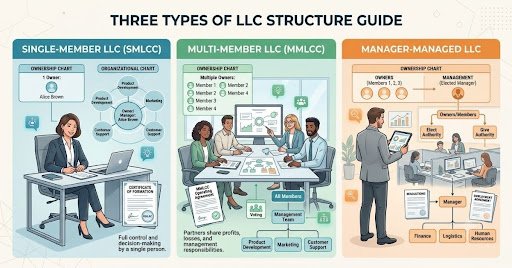
The three main types of LLC are single-member LLC (owned by one person), multi-member LLC (owned by two or more people), and manager-managed LLC (where appointed managers run operations rather than the owners). Each type works differently in terms of ownership, control, and day-to-day decision-making.
Key Takeaways
Understanding LLC Types: Why the Distinction Matters
The LLC as a structure is well understood — it combines liability protection with operational flexibility. What fewer people think about is that not all LLCs are the same. The type of LLC you have, or the type you form, affects how you are taxed, how decisions are made, and how ownership is distributed.
The distinctions between LLC types are not just technical. They have real consequences for how you run your business day to day, how profits are distributed, and what happens if an owner wants to leave. Getting this right upfront saves a lot of friction later.
Type 1: Single-Member LLC
A single-member LLC is exactly what it sounds like: a limited liability company with one owner. It is the most straightforward LLC structure and the most common choice for freelancers, solopreneurs, and consultants who want the protection of a registered entity without the complexity of a partnership.
How Ownership Works
There is one member who owns 100% of the company. That member has complete control over all decisions, all profits, and all the direction of the business. There are no other members to consult, no profit-sharing agreements to draft, and no disagreements over business direction.
How Taxation Works
By default, a single-member LLC is treated as a disregarded entity for tax purposes in the United States. This means the IRS does not treat it as a separate taxpayer — the owner simply reports business income and expenses on their personal tax return. There is no separate business tax filing unless the owner elects to be taxed as a corporation.
Best Suited For
One Limitation to Know
Because a single-member LLC is treated as a disregarded entity, some courts in certain US states have been more willing to pierce the corporate veil — meaning a creditor could potentially go after the owner’s personal assets in specific circumstances. This risk is usually manageable with proper recordkeeping and by keeping business and personal finances strictly separate.
Type 2: Multi-Member LLC
A multi-member LLC has two or more members. This is the appropriate structure when business is being built with partners — whether that is two co-founders, a family business, or an investor group.
How Ownership Works
Ownership in a multi-member LLC is typically expressed as a percentage — Member A owns 60%, Member B owns 40%, for example. This percentage often (but not always) determines how profits are split, how losses are allocated, and how much voting power each member holds. The operating agreement governs all of this, and it is one of the most important documents a multi-member LLC can have.
How Taxation Works
By default, a multi-member LLC is taxed as a partnership. This means profits and losses pass through to each member’s personal tax return in proportion to their ownership stake. The LLC itself files an informational return but does not pay income tax as an entity. Like a single-member LLC, a multi-member LLC can elect to be taxed as a corporation if that is more beneficial given the circumstances.
The Operating Agreement
With more than one member, the operating agreement becomes critical. This document sets out:
Without a solid operating agreement, these situations are governed by the default rules of the state or jurisdiction you are registered in — which may not reflect what you and your partners actually intended.
Best Suited For
Type 3: Manager-Managed LLC
The third type is less about who owns the LLC and more about how it is run. A manager-managed LLC is one where the members — the owners — have delegated the day-to-day running of the business to one or more appointed managers. Those managers may themselves be members, or they may be outside professionals hired to run operations.
This contrasts with a member-managed LLC, which is the default structure. In a member-managed setup, all members participate in running the business. In a manager-managed setup, only the designated managers have the authority to act on behalf of the company.
Why This Distinction Exists
Not every business owner wants to be involved in daily operations. Consider an LLC where two of the three members are passive investors — they contributed capital and want returns, but they have no interest in managing suppliers, hiring staff, or handling client relationships. A manager-managed structure formalises this arrangement. The active member, or an external hire, manages the business. The passive members retain their ownership interest and share in profits without operational responsibility.
Managers vs Members: Key Differences in Authority
| Member (owner) | Manager (appointed operator) |
|---|---|
| Holds ownership interest and shares in profits | Has authority to make operational decisions |
| Votes on major decisions (e.g. selling the company) | Handles day-to-day operations and vendor relationships |
| May or may not be involved in day-to-day operations | May or may not have an ownership stake |
Best Suited For
How These LLC Types Apply in the UAE
In the UAE, the LLC framework is slightly different from the US model but follows a similar ownership logic.
A UAE Mainland LLC can have between 1 and 50 shareholders, making it suitable for both sole ownership setups and multi-partner arrangements. The management structure — whether the owners manage directly or appoint a general manager — is set out in the Memorandum of Association and is governed by the UAE Commercial Companies Law.
In the Free Zone context, an FZ-LLC can be set up as a single-owner entity or a multi-shareholder company. Many Free Zones allow a single applicant to hold 100% ownership, which is the equivalent of a single-member LLC. As a business grows, additional shareholders can be added.
The manager-managed concept also exists in the UAE context. A shareholder or a non-shareholder can be appointed as the General Manager, with authority to manage day-to-day operations, sign contracts, and represent the company — while other shareholders remain as owners without operational involvement.
Frequently Asked Questions
What are the three types of LLC?
The three main types of LLC are single-member LLC (one owner), multi-member LLC (two or more owners), and manager-managed LLC (where a designated manager runs operations rather than the owners themselves). A member-managed LLC, where all owners are involved in operations, is often considered a fourth distinction.
What is the difference between a single-member and multi-member LLC?
A single-member LLC has one owner who controls 100% of the business. A multi-member LLC has two or more owners whose rights, responsibilities, and profit shares are defined by an operating agreement. Both offer the same liability protection but differ in management, taxation, and internal governance.
What is a manager-managed LLC?
A manager-managed LLC is one where members (owners) have appointed a manager to run the business. The manager handles day-to-day operations and has the authority to make decisions on behalf of the company. Members retain their ownership interest and share in profits without needing to be operationally involved.
Can a single-member LLC have employees?
Yes. A single-member LLC can hire employees even though it has only one owner. The LLC is a separate legal entity and can enter employment contracts, run payroll, and take on staff in the same way any other business entity would.
Which type of LLC is best for a startup with two founders?
A multi-member LLC with a well-drafted operating agreement is generally the right structure for two co-founders. The operating agreement should clearly set out ownership percentages, decision-making processes, and what happens if one founder wants to exit — before those situations actually arise.
How does an LLC work in the UAE compared to the US model?
In the UAE, a Mainland LLC can have 1 to 50 shareholders and is governed by the UAE Commercial Companies Law. Free Zone LLCs follow a similar principle but are regulated by the relevant Free Zone authority. Both allow for full foreign ownership in most cases, and both provide limited liability protection to shareholders. The core principles — ownership, liability protection, and flexible management — are consistent with the global LLC concept.
Final Thoughts
The type of LLC you choose shapes how your business is owned, managed, and taxed from day one. For most solo operators, a single-member structure is the cleanest starting point. For partnerships, the multi-member LLC with a solid operating agreement is the right foundation. And when the business grows to the point where separating ownership from management makes sense, the manager-managed model offers that flexibility without the formality of a corporation.
Whether you are setting up in the US or in the UAE, the underlying logic is the same: choose the structure that fits how you actually plan to operate — not the one that sounds most impressive on paper.
post tags :
Freelance Visa & Digital Nomad Visa Dubai
Whether you’re a creative designer, tech developer, marketer, consultant, or remote employee working for an overseas company — the Freelance Visa Dubai and Digital Nomad Visa Dubai give you the freedom to live and work legally in the UAE while enjoying a modern lifestyle and tax-free income.