
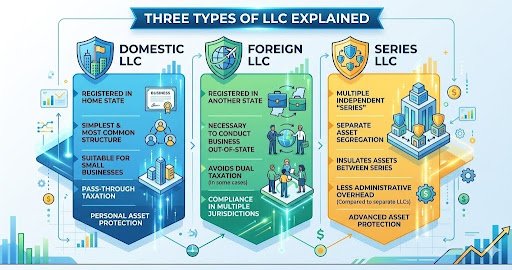
The 3 types of LLC are domestic LLC (registered and operating in the same state or country), foreign LLC (registered in one jurisdiction but operating in another), and series LLC (a single parent LLC that can hold multiple protected sub-units under one registration). Each type serves a different business need and offers a different level of operational flexibility.
Key Takeaways
Why There Are Different Types of LLC, and Why It Matters
Most people form an LLC and get on with running their business without ever thinking about what type of LLC they actually have. That works fine, until the business expands across state lines, grows into multiple ventures, or moves into a new market. At that point, the type of LLC matters quite a bit.
The three types covered in this article address three different situations: operating locally, operating across jurisdictions, and managing multiple business lines under a single registration. Understanding which one applies to your situation helps you stay compliant, keep your liability protection intact, and avoid surprises when your business grows.
Type 1: Domestic LLC
A domestic LLC is the most common and straightforward type. It is simply an LLC that is formed in a particular state or country and operates within that same jurisdiction. When someone says ‘I have an LLC,’ this is almost always what they mean.
How It Works
You register the LLC with the relevant state or national authority, pay the required fees, and operate your business under that registration. The LLC is subject to the laws, tax rules, and compliance requirements of the jurisdiction where it was formed.
Who It Is For
Key Considerations
The domestic LLC works cleanly as long as the business stays within the jurisdiction. The moment you start conducting meaningful business operations in another state or country, you may need to register as a foreign LLC in that additional location, which brings us to type two.
Type 2: Foreign LLC
A foreign LLC is not a company from another country, the word ‘foreign’ here is a legal term referring to any LLC that was originally formed in one jurisdiction but is operating in a different one. If you formed your LLC in Delaware but now operate primarily in California, your LLC is a domestic entity in Delaware and a foreign entity in California.
This distinction matters because most jurisdictions require businesses operating within their borders to register locally, even if that business is already legally registered elsewhere. This is called foreign qualification.
What Foreign Qualification Means
Foreign qualification is the process of registering your out-of-state LLC with the state where you are conducting business. It does not create a new LLC, your entity stays the same. It simply gives you legal permission to operate in that additional state, and it brings you under that state’s reporting, fee, and compliance requirements.
When You Need to Foreign-Qualify
What Happens If You Do Not
Operating in a state without foreign qualification can result in penalties, back-owed fees, and in some cases the inability to sue or enforce contracts in that state until you are properly registered. It is not a comfortable situation to be in, and it is entirely avoidable with proper planning.
In the UAE Context
The foreign LLC concept has a direct parallel in the UAE. A company registered in a Free Zone is considered a Free Zone entity and is not automatically permitted to trade on the UAE Mainland. To conduct business on the Mainland, that company either needs a Mainland license or must operate through a licensed local distributor. This is essentially the same principle: you must be registered in the jurisdiction where you operate.
Type 3: Series LLC
The series LLC is the most advanced of the three types and is also the least widely known. It allows a single parent LLC to create multiple internal sub-units, called series or cells, each of which has its own segregated assets, liabilities, and operations.
Think of it as one legal umbrella with multiple independent compartments underneath it. A problem in one series, a lawsuit, a debt, a failed project, does not automatically affect the other series or the parent LLC.
A Practical Example
Say you own three rental properties and you want to protect each one from the liability exposure of the others. With a standard LLC, all three properties sit in the same entity. A lawsuit over one property can reach the assets of the other two. With a series LLC, each property sits in its own series. The liability stays contained within that series, and the other properties are not exposed.
This is the core appeal of the series LLC: it provides the liability separation of multiple individual LLCs but at the cost and administrative complexity of a single registration.
Where Series LLCs Are Available
Series LLCs are currently available in a limited number of US states, including Delaware, Texas, Nevada, and Illinois, among others. They are not recognised in all states, which means a series LLC formed in Delaware may face ambiguity when it tries to operate in a state that does not have series LLC legislation.
Limitations to Know
In the UAE Context
The UAE does not have a series LLC structure as defined under US law. However, the equivalent intent, operating multiple business lines under a single umbrella with some degree of separation, is achieved differently. A single UAE trade license can cover multiple business activities, allowing one entity to legally operate across several service areas. For deeper separation, a holding company structure (a parent entity owning multiple subsidiaries) achieves similar results.
Side-by-Side: The 3 Types of LLC
| Feature | Domestic LLC | Foreign LLC | Series LLC |
|---|---|---|---|
| Purpose | Standard local operation | Multi-jurisdiction operation | Multi-venture under one entity |
| Registered in | One state/country | Formed elsewhere, qualifies here | One state with series legislation |
| Separate legal entity | Yes | Same entity, new jurisdiction | Parent + independent sub-units |
| Liability protection | Standard LLC protection | Standard LLC protection | Separated per series |
| Complexity | Low | Moderate | High |
| Best for | Most small/mid businesses | Multi-state operators | Multi-property / multi-venture owners |
Frequently Asked Questions
What are the 3 types of LLC?
The three types are domestic LLC (formed and operating in the same jurisdiction), foreign LLC (formed in one jurisdiction but operating in another, requiring additional registration), and series LLC (a single parent LLC that holds multiple independent sub-units, each with separate liability protection). The domestic LLC is by far the most common.
What is a foreign LLC?
A foreign LLC is not a company from another country. The term refers to any LLC that was formed in one state or jurisdiction but is now conducting business in a different one. Most states require you to register, or ‘foreign qualify’, your LLC in any state where you actively operate, even if the entity was formed elsewhere.
What is a series LLC and how does it work?
A series LLC is a parent LLC that can create multiple internal sub-units, each with its own assets, members, and liability protection. Each series operates independently, a liability or debt in one series does not automatically affect the others. Series LLCs are available only in specific US states and are not universally recognised across all jurisdictions.
Do I need a domestic LLC in each state I operate in?
Not necessarily. You do not form a new LLC, you foreign-qualify your existing LLC in each state where you conduct business. The threshold for what counts as ‘conducting business’ varies by state, but generally includes having a physical presence, employees, or regular commercial activity in that state.
Is there a series LLC equivalent in the UAE?
The UAE does not have a series LLC structure. However, similar goals can be achieved through a holding company structure, where a parent entity owns separate subsidiary LLCs for each business line. This provides liability separation between business lines while maintaining centralised ownership. A single UAE trade license covering multiple activities is another option for simpler multi-activity businesses.
Which type of LLC is best for a small business?
For most small businesses operating in one location, a domestic LLC is the right choice. It is straightforward, cost-effective, and provides the liability protection and flexibility that most small business owners need. A foreign LLC or series LLC only becomes relevant when the business operates across multiple jurisdictions or needs to manage distinct liability pools for different ventures.
Final Thoughts
Most business owners will work with a domestic LLC throughout the life of their company and never need to think about the other types. But knowing that foreign qualification is required when you expand into new states, and that a series LLC exists for complex multi-venture structures, means you will not be caught off guard when growth creates new compliance obligations.
The underlying principle is the same across all three types: an LLC is a flexible structure designed to protect its owners while keeping administration manageable. The type you need depends on where you operate, how many ventures you run, and how much separation you want between them.
Thinking about registering an LLC in the UAE? Trivup helps individuals and businesses set up the right structure, Free Zone, Mainland, or Offshore, based on where and how they plan to operate.
post tags :
Freelance Visa & Digital Nomad Visa Dubai
Whether you’re a creative designer, tech developer, marketer, consultant, or remote employee working for an overseas company — the Freelance Visa Dubai and Digital Nomad Visa Dubai give you the freedom to live and work legally in the UAE while enjoying a modern lifestyle and tax-free income.